
Why We Picked This Event
The teacher was going to be Liliana Chenlo, a visiting teacher from Buenos Aires, Argentina, currently residing in Miami. I remembered her from one of the Tango at the Beat on Monday nights as one of the visiting dancers. I had not met her in person at the time, but even from my very serious role as a bench observer, her tango skills stayed in my mind. Now you understand that I had no idea she was a professional tango dancer and teacher. When I found out on My Events Bridge that she was going to hold the class before the milonga with one of her colleagues Ana Thomas, I did not want to miss the opportunity. Ana Thomas is also from Buenos Aires, currently residing in Las Vegas and teaching at Las Vegas Tango Academy.
What Is “Luna Azul Milonga”?
Matthew (Mat) MaMoody is the host of the night for Luna Azul Milonga and Michael Arntz is the DJ. They also host Thursday night milongas at Allegro and again with special guests for workshops.
Mat has been dancing and teaching Argentine Tango for several years following his competitive career in ice dancing and pairs figure skating. He specializes in Exhibition / Performance style of Argentine Tango.
I first met Michael Arntz when he was a special guest DJ at Spire Tango. Michael Arntz combines his years of experience as a tango dancer, professional DJ, and performing musician to create traditional milongas, with a focus on Golden Age Tango from the 1930s to the 1950s. Michael has been a part of the San Francisco Bay Area Tango and International Tango Festival scene since 2001.
Event Details
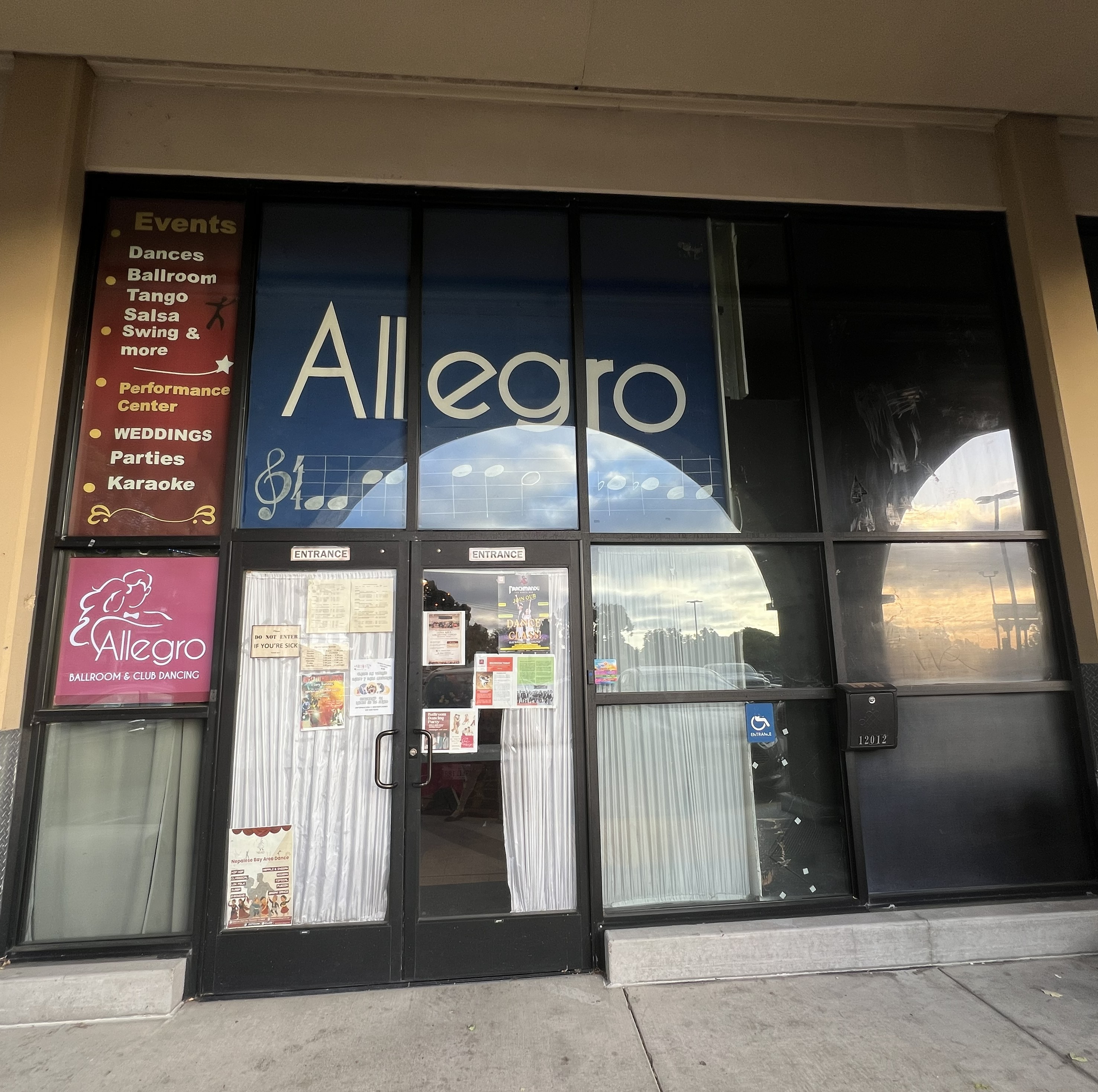
Location: 12012 San Pablo Avenue, Richmond, CA 94805.
Time: 7:00 pm–7:30 pm beginner class; 7:30 pm–9:00 pm workshop; 9:00 pm–12:00 am milonga.
Parking: Free parking is available in the Allegro Ballroom/Grocery Outlet parking lot. Street parking is available on nearby streets, such as Key Blvd.
Fee: Workshop + Milonga $25 USD, $20 USD for Allegro members; Milonga + Performance $15 USD.
Payment: Credit card or cash. You can pay at the front desk. A volunteer will welcome you, check you in, and give you a wristband so you can go in and out for fresh air easily if you’d like to.
When: Every second and fourth Saturday, and fifth Saturdays depending on the month.
Food & Drinks: Light snacks are provided, including fruit, cookies, potato chips, pretzels, and mixed nuts. Some regulars also bring wine to share.
About the Location — Allegro Ballroom
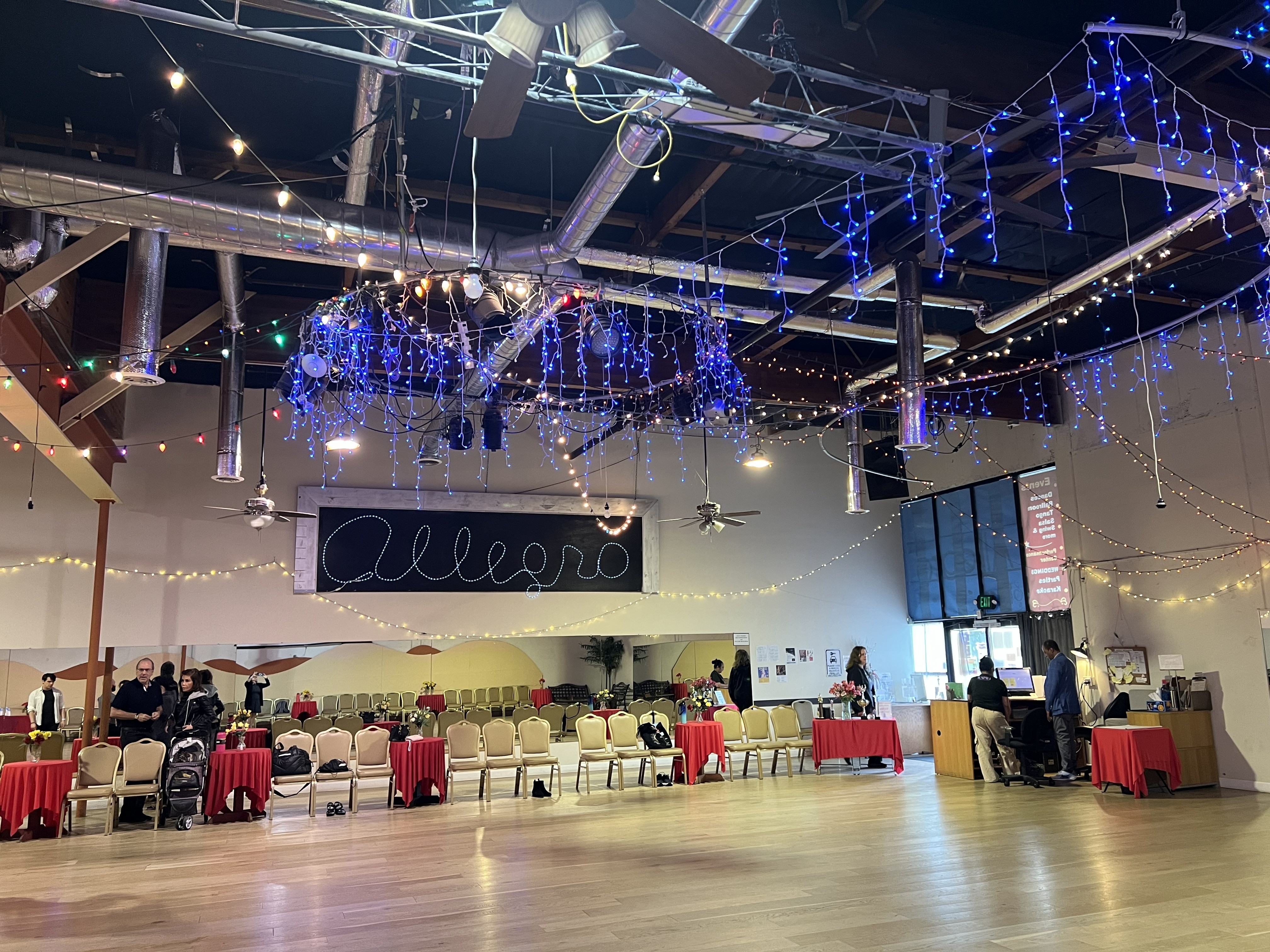
Founded in 1994 by Allegro Dancers, Inc., a nonprofit dedicated to affordable dance education and community space, Allegro Ballroom was a longtime fixture of Emeryville’s arts scene before relocating to Richmond in 2019. The venue is operated by members, volunteer DJs, and an elected Board of Directors. During our tour, a board member showed us the facility, located next to Grocery Outlet. Allegro features five ballrooms of varying sizes, allowing multiple events to run simultaneously. The spaces are available for private events, classes, rehearsals, and dance practice, and include sprung wood floors, mirrors, sound systems, lighting, tables, and chairs.
A Quick Guide to Feeling Ready for the Night
Shoes
Proper dance shoes with leather or suede soles are recommended for easy pivoting—either heels or flats. Personally, I chose flats for the workshop and kept those for the remainder of the milonga.
Dress Code
This is a traditional milonga. As usual, it is important that you feel comfortable in your dress while you are dancing.
Partner
No partner needed; you can dance with anyone. The hardest part may be deciding who to cabeceoA traditional tango invitation using eye contact and a small nod, instead of walking directly across the room to ask someone to dance. first.
Asking for a Dance
CabeceoThe leader looks at the follower, the follower meets the leader’s eyes through mirada, the leader nods, and the follower responds to the nod with a nod. rules are followed. In tango, cabeceo is a traditional way to invite someone to dance through eye contact and a nod, rather than walking directly across the room to ask.
Skill Levels
Beginners are welcome. Although I did not attend the beginner class, I arrived while it was underway. The atmosphere felt welcoming, with music already playing and dancers warming up for the evening. I also noticed Mat taking time to dance with newer attendees, helping create a comfortable environment before the workshop and milonga began.
Some people came specifically for the workshop, like my partner and me, while others seemed to be regulars at Allegro Ballroom’s Saturday milongas.
Snacks & Water
Some light snacks are provided, including fruit, cookies, potato chips, pretzels, and mixed nuts. Some regulars also bring wine to share. It is enough to keep dancers fueled between tandas without turning the evening into a full dinner stop.
Vibe
Other than three people I knew from Tango at the Beat, most faces were new to me. Many seemed to be Allegro Ballroom Saturday Milonga regulars — people Mat knows by name — but not necessarily dancers I had seen often at the other milongas I have visited so far. In this event, the tandasSets of tango songs, usually danced with the same partner before a short musical break called a cortina. consisted of 4 songs.
Crowd Size
28–30 people for the milonga; 18 people for the class.
It was both Memorial Weekend, when many people were traveling, and ATUSA happening in San Francisco. Between vacation plans and tango championships, the dance floor had some serious competition for people’s attention that weekend.
The smaller crowd made navigation easy, and there was plenty of room to move comfortably. If you happened to be working on a new milonga pattern, there were even a few quiet corners where you could practice between dances—strictly for research purposes, of course.
Liliana mentioned that she will visit the San Francisco Bay Area again. My recommendation: definitely take her workshop, particularly if she focuses on milonga again.
Stories from the Dance Floor
As Liliana and Ana arrived for the class, Liliana announced that the topic would be “milonga.” Yay! My feet were excited. My brain was about to learn several new words in Spanish.
I have attended many tango classes and workshops over the years, but somehow this was my first workshop dedicated specifically to milonga. Yes, really. At this point I was beginning to suspect that milonga workshops were avoiding me on purpose. So here are a few beginner-friendly terms for milonga steps:
LisaThe smooth, walking style of milonga using simple steps and a steady rhythm without syncopation.
The simplest way to dance milonga—just walking to the beat with smooth, natural steps. Think of it as the foundation of the dance, helping beginners stay connected to the music and their partner.
TraspiéA quick double weight change that creates a lively quick-quick-slow feeling in milonga.
A quick “double-step” rhythm where you change weight twice in rapid succession before continuing. It gives milonga its playful, bouncy feeling, like taking a tiny extra step to catch the music.
AmagueA feint or fake-out where a movement is suggested, then redirected before it fully happens.
A “fake-out” or feint. The leader starts to lead one movement, then changes direction before it happens. It creates surprise and musicality without requiring large or complicated steps.
La BichitaA compact, playful rhythmic sequence with quick weight changes, often danced in place or with very little travel.
A small, playful rhythmic sequence often danced in place or with very little travel. It uses quick weight changes and compact footwork, making it useful on crowded dance floors while adding a fun, energetic feel.
Hoola (or “Hula”)A playful side-to-side movement where the couple sways or rotates slightly while maintaining connection.
A playful side-to-side movement where the couple sways or rotates their hips and torso slightly while maintaining connection.
Side Step AmericanaA side step in Americana position, where partners face the same direction and move together while maintaining a V-shaped connection.
A side step performed in the Americana position, where both partners face the same direction, similar to a promenade position in ballroom dancing. The couple moves sideways together while maintaining a V-shaped connection, creating a smooth traveling feeling.
Easy Way to Remember Them
- Lisa = Walk
- Traspié = Double-step
- Amague = Fake-out
- La Bichita = Playful quick-foot pattern
- Hoola = Rhythmic side-to-side motion
- Side Step Americana = Side step in promenade/Americana position
These six concepts form a large part of social milonga dancing: Lisa provides structure, Traspié adds rhythm, Amague adds surprise, La Bichita adds playful embellishment, Hoola develops musicality through relaxed side-to-side motion, and Side Step Americana introduces smooth traveling movement as partners progress together in the same direction.
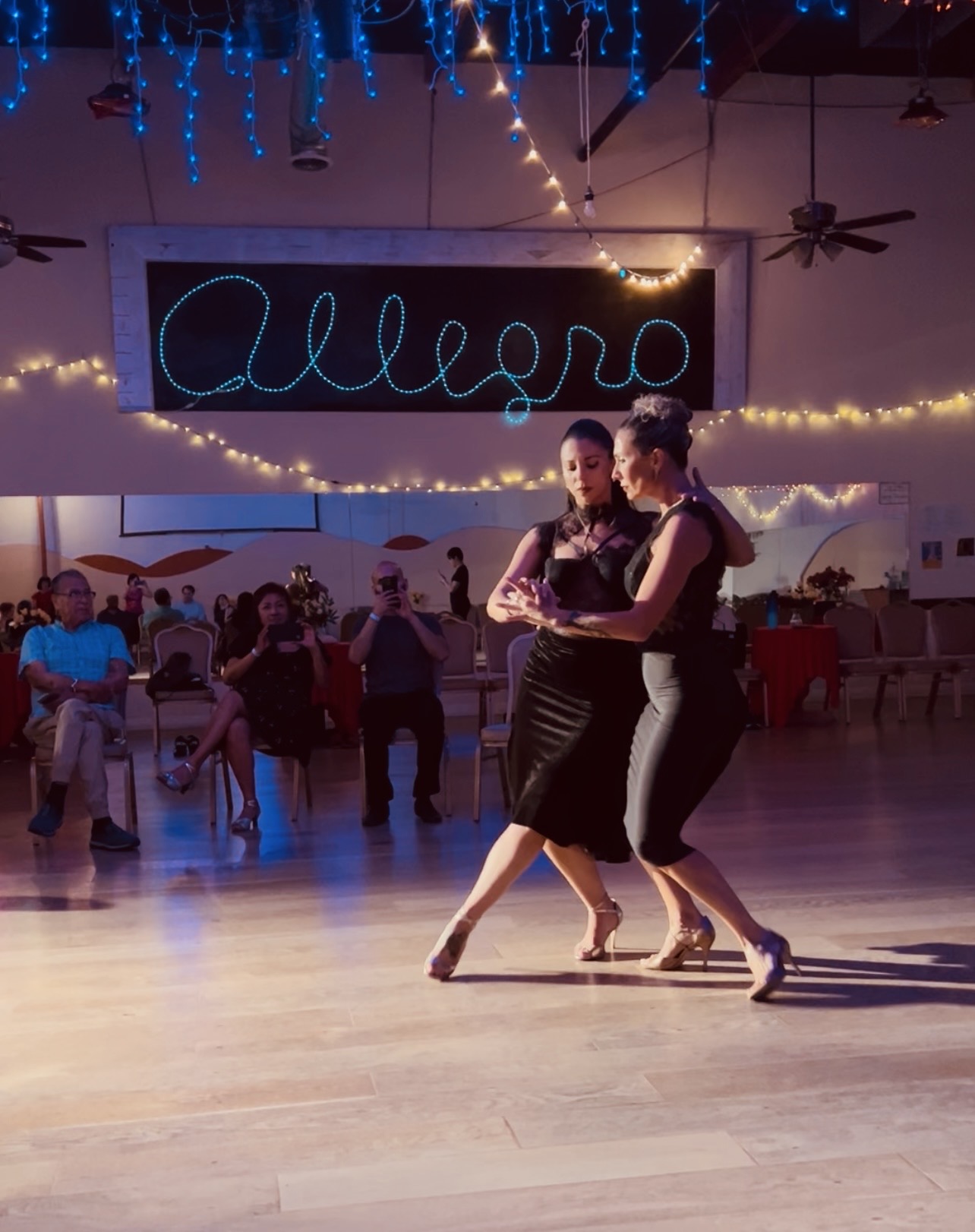
The evening also included a performance by Liliana Chenlo and Ana Thomas. They danced three songs, showcasing the musicality, connection, and elegance that had been the focus of the workshop earlier in the night. Watching the instructors demonstrate on the social dance floor brought many of the concepts from class to life. Fortunately, I had my camera ready and was able to record the performance, and you can see one of the photos I captured from the evening on this page.
Summary
This was my first time at Allegro Ballroom after their move to Richmond. If the location moves, does the soul of the event change with the location? There is only one way to investigate this important tango mystery: put on your dance shoes and show up. I picked Saturday as I was following a tango teacher that I was curious about. If your favorite tango teacher is also coming to your area at Allegro, check My Events Bridge for Thursdays and Saturdays in Richmond and follow Luna Azul Milonga’s schedule.
Support the Rhythm
Every review on My Events Bridge is created from an actual visit, not from a flyer, rumor, or tango telepathy. If this helped you decide where to dance next, consider supporting the work behind the platform through Buy Me a Coffee.
Your support helps sustain the time spent attending events, writing reviews, and maintaining a space where dancers can explore Richmond and Bay Area dance events and connect through movement with more awareness.
Sharing this platform, returning when planning your next dance, or inviting a friend to explore the page helps keep this rhythm moving forward.
Thank you for being here.
Back to Blog